Quick answer
- • "M/cte" = "moneda corriente" (current Colombian pesos)
- • Appears on public deeds, contracts and purchase promises
- • Not required on DIAN invoices or standard bank checks
- • Usually accompanied by the ",oo" suffix for whole values without centavos
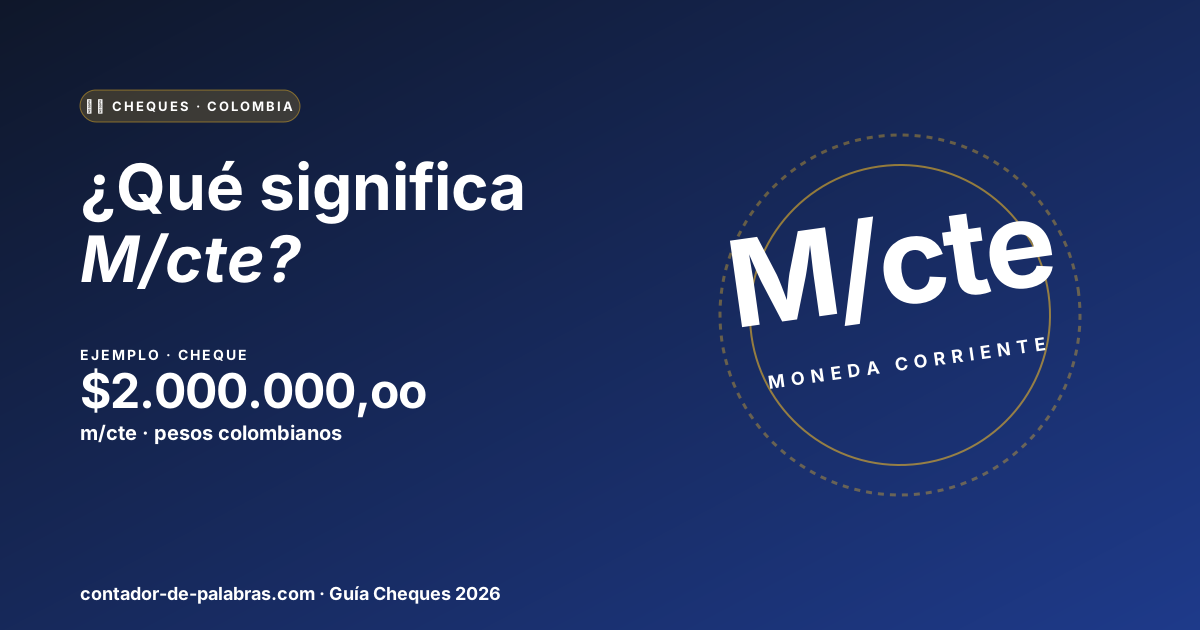
- • Example:
DOS MILLONES DE PESOS M/CTE ($2.000.000,oo)
If you have reviewed a real estate purchase deed, a sale promise or a notarial document in Colombia, you have surely seen the letters "M/cte" or "MONEDA CORRIENTE" next to the price in pesos. This guide explains what it means, when to use it, why it is accompanied by the strange ",oo" suffix, and how to write amounts correctly in Colombian documents.
If you only need to convert a figure to the correct notarial format, use our free Colombian pesos to words converter: it generates the exact format with M/cte and ",oo" in one click.
What does the abbreviation M/cte mean?
"M/cte" (also written "M/CTE", "M. cte." or "MONEDA CORRIENTE" in uppercase) is the abbreviation for moneda corriente (current currency). In Colombia it indicates that an amount is expressed in current Colombian pesos, that is, the country's legal tender (ISO 4217 code: COP).
It is functionally equivalent to Mexico's "M.N." (Moneda Nacional), although Colombian practice additionally adds the ",oo" suffix at the end of whole values (more on this below).
"M/cte" is a Colombian notarial convention, not a tax requirement. It appears on legal documents — deeds, promises, wills — to reinforce that the amount refers to current Colombian pesos and not to another historical or foreign currency.
Which documents use M/cte?
The use of "M/cte" is practically universal in these types of Colombian documents:
- Public deeds for real estate purchase: the price is written in words + M/cte + figure in parentheses.
- Purchase promises (promesas de compraventa): preceding the deed, already use the format.
- Mortgages and loans: the principal and interest appear this way.
- Wills: monetary bequests follow the convention.
- Notarized promissory notes: though simple bank promissory notes do not always include it.
By contrast, it is not required (though it sometimes appears) on:
- DIAN electronic invoices: the UBL 2.1 XML does not require any suffix; the numeric value is enough.
- Bank checks: the Superintendencia Financiera requires the amount in words, but not "M/cte" specifically.
- Cash receipts and informal vouchers.
The ",oo" suffix: why it appears at the end
Alongside "M/cte" another Colombian peculiarity almost always appears: the ",oo" suffix at the end of the figure in parentheses. Example:
DOS MILLONES DE PESOS M/CTE ($2.000.000,oo)
The two lowercase "o" letters replace the centavos in whole figures. They are not zeros (00) or random letters: they visually represent that the amount has no centavos. It is equivalent to the "00/100" you would see on Mexican or Argentine checks, but adapted to Colombian use.
Why was this notation invented? For a historical reason: although legally the Colombian peso divides into 100 centavos, the Banco de la República stopped minting centavos in 1984 due to inflation. Since then, accounts in Colombia have been kept in whole pesos, and ",oo" remains as a formal closure on notarial documents — not to indicate active centavos, but to "close" the amount and prevent subsequent alterations.
How to write the complete M/cte + ,oo format
The canonical format accepted by Colombian notaries has four elements in order:
- Amount in uppercase letters (DOS MILLONES DE PESOS)
- "M/CTE" suffix (or full "MONEDA CORRIENTE")
- Figure in parentheses with period thousand separator ($2.000.000)
- ",oo" suffix for whole values, or ",X0" if there are decimals (although they almost never apply)
Correct examples:
QUINIENTOS MIL PESOS M/CTE ($500.000,oo)UN MILLÓN DOSCIENTOS CINCUENTA MIL PESOS M/CTE ($1.250.000,oo)DOSCIENTOS CINCUENTA MILLONES DE PESOS M/CTE ($250.000.000,oo)— standard purchase in Bogotá
Automatic generator: Colombian pesos to words converter
Instead of writing each document by hand and risking errors of apocope, gender or agreement, use our free Colombian pesos to words converter. It has three modes:
- DIAN invoice: sentence case without suffix (for invoice PDFs).
- Check: uppercase (Superintendencia Financiera format).
- Notarial: uppercase + M/cte + ($X.XXX.XXX,oo) — the canonical format for Colombian deeds.
Click "Copy for notary" and the text is ready to paste into your document. Works in the browser, no signup or server transmission.
Differences with other Hispanic countries
- 🇨🇴 Colombia:
M/cte+,oo(compound) - 🇲🇽 Mexico:
M.N.(Moneda Nacional) +00/100 - 🇦🇷 Argentina: no standard suffix, sometimes
m/n(rarely used today) - 🇨🇱 Chile: no suffix, no centavos by convention (since 1984)
- 🇵🇪 Peru: no suffix, but uses the conjunction
"y"between soles and céntimos - 🇪🇸 Spain (euros): no suffix, but distinguishes
€(text) fromEUR(systems)
For other currencies, see our specialized converters by country.
Frequently asked questions
Is "M/cte" written in uppercase or lowercase?
Both forms are accepted. In all-uppercase notarial documents it appears as "M/CTE"; in mixed text as "M/cte". Consistency with the document matters.
Is "M/cte" the same as "MN" or "moneda nacional"?
Functionally yes: both indicate the local current currency. But "M.N." is the Mexican convention and "M/cte" is Colombian.
Can I write "moneda corriente" in full?
Yes. The full form "PESOS MONEDA CORRIENTE" is perfectly valid and appears in more formal or older deeds. The abbreviated "M/cte" is more compact and used in modern documents.
Is M/cte legally required on public deeds?
Not by codified law. It is notarial practice of the Superintendencia de Notariado y Registro. Notaries can return documents without M/cte requiring it to be added.
Sources
- Superintendencia de Notariado y Registro de Colombia
- Banco de la República de Colombia · Numismatics
- Real Academia Española · Ortografía 2010
- Colegio de Notarios de Bogotá · public formats