Cloning your voice with AI no longer takes a studio or hours of recording: a short, clean sample is enough. What almost nobody explains is what to say in that sample. This guide covers the text speech engineers have used for decades (and the two lines it is missing), how to record it, how many characters a minute of speech is (the unit these services bill by) and what the law says about cloning voices.
To clone your voice you need a clean recording of at least 15 seconds, one voice, no music. Read Harvard sentences list 1 (about 34 seconds) plus one question and one exclamation of your own, upload it to a voice cloner and write your script: a minute of speech is about 860 characters. Clone only your own voice, or one you have written permission to use.
Voice cloning is not the same as text to speech
Text-to-speech tools read what you type with stock voices: correct, but nobody's. Cloning adds a step before that. From a recording of you, the model learns your timbre, your accent and the way you pitch a sentence, and builds a voice that sounds like you and can read any text. That is what lets you narrate a course, an audiobook or a channel's videos without recording every line, and fix a mistake by editing one word of the script instead of redoing the take.
The practical consequence: the sample is everything. The model only knows what it hears. Record with echo and the clone has echo; read listlessly and the clone sounds listless; leave a sound out and the model has to guess how you say it.
What to read: the Harvard sentences
Speech engineers solved the "what do I read?" problem in 1969. The IEEE's Recommended Practice for Speech Quality Measurements published 72 lists of 10 short sentences, the Harvard sentences, built to be phonetically balanced: each list packs the sounds of English in roughly the proportions they occur in everyday speech. They have been used ever since to test telephones, codecs and speech recognition, which makes them a natural fit for a cloning sample.
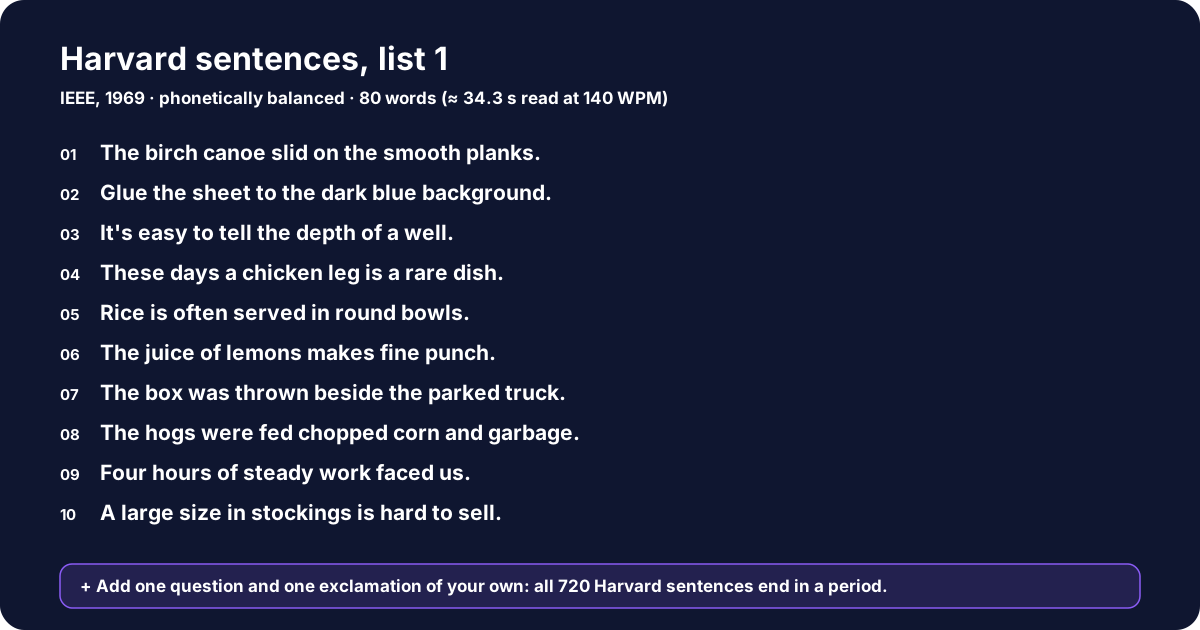
The Harvard sentences have one gap for this job: all 720 of them end in a period. There is not a single question or exclamation in the set, so a sample built only from them never shows the model how your voice rises at the end of a question or lifts when you are excited. Add one of each:
Three things to keep in mind while you read:
- Use your own accent. Do not flatten it into a "neutral" read. The clone should sound like you, not like a generic announcer.
- Use the tone you want to hear later. If the clone will narrate upbeat videos, read with energy. If it will read an audiobook, read slowly.
- If the service accepts more time, use it. Read list 2 as well, or add a paragraph of something you will actually narrate. More clean audio is more information about your voice.
How to record a clean sample
You do not need a studio microphone. You need to avoid the four flaws that ruin a clone: echo, background noise, clipping and plosives.
- Pick a room with soft things in it. A bedroom with curtains, a sofa or an open closet has far less echo than a kitchen or a bathroom.
- Turn off everything that makes noise. Music, TV, fans, notifications. The sample should contain one voice: yours.
- Keep the microphone about a hand's width from your mouth and slightly to the side, so the air from your p's and b's does not hit it.
- Record at the best quality available, in WAV if your recorder offers it, and check that the waveform never hits the ceiling on the exclamation.
- Do two or three takes, keep the cleanest and trim the long silences at the start and the end.
Clone your voice and generate the audio
Once the sample is recorded, the rest is quick. With an AI voice cloner like AnyVoice you upload or record the sample (MP3, M4A or WAV, from 15 seconds to 4 minutes and up to 20 MB, one voice), confirm the voice is yours or that you have permission to use it, and a few seconds later you have a model of your voice that can read any text in more than 80 languages. It can strip background noise from the sample, it charges 1 credit per character, so the math in the next section works as a budget as-is, and new accounts get 5,000 free credits with no card required: about 5.8 minutes of English speech.
From there, the work is text again. Write the script the way you would say it, not the way you would write it: short sentences, no parentheses, punctuation wherever you want a pause. Generate, listen to the whole result and, if a word comes out wrong, do not regenerate blindly: rewrite it in the script. A foreign name spelled the way it sounds, or an acronym split into letters, usually fixes it.
Numbers, dates and abbreviations deserve special care. "5/6" can be read as May 6 or June 5, and "St." as Saint or Street. Write them the way you want them spoken. For amounts, the number to words converter spells out any figure without mistakes.
How many characters is a minute of speech?
AI voice services do not bill by the minute; they bill by the character. To know how much text a given length of audio needs, you need two numbers: the speaking pace, about 140 words per minute (the middle of the natural 130 to 150 range), and how many characters a word takes. We measured the second one: across 18,998 words of prose on our own English blog, a word averages 6.14 characters including the space that separates it from the next, and 5.14 without it.
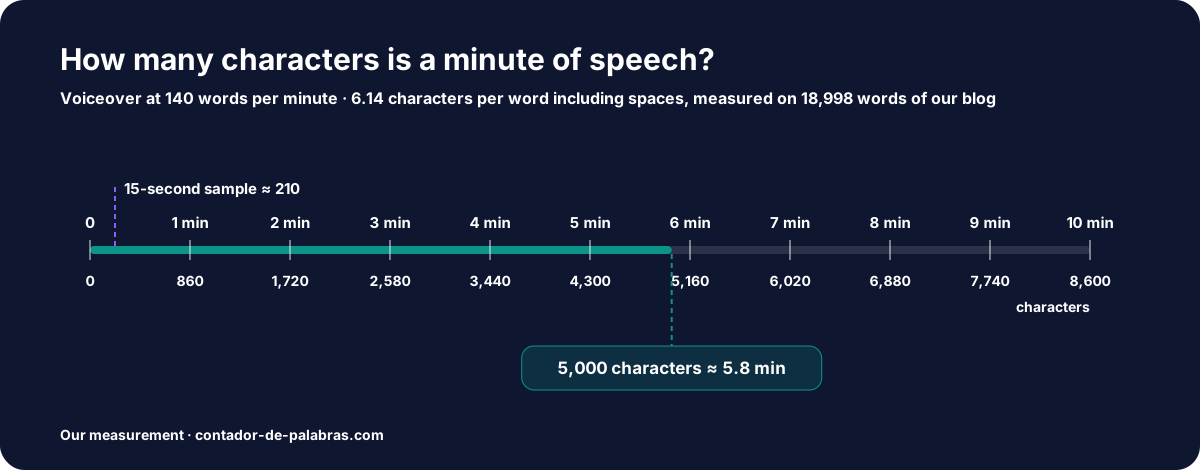
| Audio length | Characters with spaces | Without spaces |
|---|---|---|
| 15 seconds | ~210 | ~180 |
| 1 minute | ~860 | ~720 |
| 3 minutes | ~2,580 | ~2,160 |
| 5 minutes | ~4,300 | ~3,600 |
| 10 minutes | ~8,600 | ~7,200 |
| 30 minutes | ~25,790 | ~21,590 |
Check whether your service counts spaces: the difference is about 16%. The character counter shows both figures at once, so paste the script in before you generate and you will know exactly what it costs. Spelling numbers out also lengthens the text: "1,250" is 5 characters and "one thousand two hundred fifty" is 30.
Clone only voices you have permission to use
A voice is a protected personal trait, and cloning someone else's without consent is not a gray area:
- In the United States, protection varies by state. California is the classic example: Civil Code section 3344 makes anyone who knowingly uses another person's "name, voice, signature, photograph, or likeness" for advertising or selling without consent liable for damages.
- In the European Union, Article 50 of the AI Act requires anyone who publishes AI-generated audio that resembles a real person to disclose that it is artificial, from August 2, 2026.
- Everywhere else, the prudent rule is the same: your own voice, or one you have written permission to use.
In practice: clone your own voice, get signed consent if you clone a collaborator's, do not imitate public figures and, when you publish, say the voice is synthetic. Reputable cloners already ask you to confirm consent before they create the voice. (This is general information, not legal advice.)
Frequently asked questions
How many seconds of audio do I need to clone my voice?
What should I read to clone my voice?
How many characters is a minute of audio?
Can a cloned voice speak other languages?
Is it legal to clone someone else's voice?
What is the difference between voice cloning and text to speech?
Related tools and articles
Character Counter
Count your script's characters.
Open →AnyVoice
Clone your voice from 15 seconds of audio.
Try it →Number to Words
Figures the voice won't misread.
Open →Words per minute of audio
The pace of a voiceover.
Read →Next: how many words is a minute of audio · how to convert text into a podcast · how to write AI image and video prompts.