Quick answer
- • The CFDI 4.0 XML has no field for the amount in words: the SAT's Anexo 20 does not include it
- • It belongs to the printed representation (the PDF), a convention inherited from paper invoicing
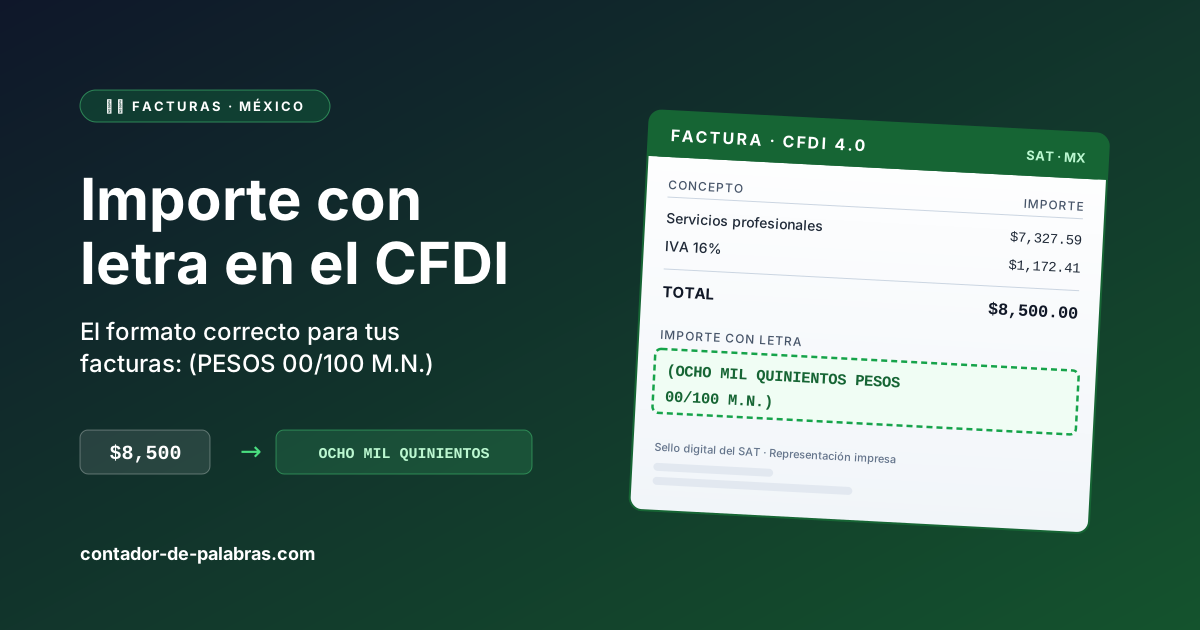
- • Standard format:
(OCHO MIL QUINIENTOS PESOS 00/100 M.N.)— in parentheses and uppercase - • Cents are written as the fraction xx/100, never with a decimal point
- • A missing amount in words on the PDF carries no fine: fiscal validity comes from the stamped XML
If you issue invoices in Mexico, you have seen the importe con letra line: the total written out in words, in parentheses, right under the numeric amount. And you have probably wondered whether the SAT (Mexico's tax authority) actually requires it, how exactly it should be written, and what happens if your invoicing software generates it with a spelling mistake.
This guide answers those three questions with the regulations in hand and reviews the most common mistakes. If you just need the correct text right now, our Mexican pesos to words converter generates the invoice format in one click.
Does the SAT require the amount in words?
Short answer: not in the CFDI itself. The CFDI (Comprobante Fiscal Digital por Internet) is an XML file whose structure is defined by Anexo 20 of the Miscellaneous Fiscal Resolution. If you inspect the CFDI 4.0 nodes — Comprobante, Emisor, Receptor, Conceptos, Impuestos — you will find the Total attribute as a numeric value, but no field for the amount written in words.
So where does it come from? From the printed representation: the human-readable PDF that accompanies the XML. The habit dates back to paper invoices, where writing the amount in words made tampering harder, just like on a check. Most invoicing systems (the SAT's own portal, Contpaqi, Aspel, Facturama and the like) add it to the PDF automatically because clients expect it — not because any rule demands it.
The practical consequence: if your invoice PDF is missing the amount in words, or shows it with a typo, the invoice remains valid. The fiscal document is the stamped XML; the PDF is only its representation.
The correct format, element by element
Even though it is not mandatory, it is worth writing correctly: it is the line your client reads to confirm the amount. The format consolidated across Mexico has four elements:
1. In parentheses
Mexican convention wraps the amount in parentheses: (OCHO MIL QUINIENTOS PESOS 00/100 M.N.). This is not an SAT rule but a typographic inheritance from printed invoicing that virtually every invoicing system respects.
2. In uppercase
The whole text goes in capital letters for legibility and to make alterations harder, just like on checks. Remember that Spanish capital letters do keep their accents: «VEINTIDÓS», not «VEINTIDOS».
3. Cents as the fraction xx/100
Decimals are expressed as a fraction of one hundred: 50/100 for fifty cents, 00/100 when the amount is exact. They are never written as "con cincuenta centavos" or as ".50" on the words line.
4. The «M.N.» closing
«M.N.» stands for Moneda Nacional (national currency) and identifies the amount as Mexican pesos. It goes after the fraction: …PESOS 00/100 M.N.).
Complete examples:
$8,500.00→(OCHO MIL QUINIENTOS PESOS 00/100 M.N.)$1,250.50→(UN MIL DOSCIENTOS CINCUENTA PESOS 50/100 M.N.)$21,000.00→(VEINTIÚN MIL PESOS 00/100 M.N.)$1,000,000.00→(UN MILLÓN DE PESOS 00/100 M.N.)
Common mistakes on invoices
- «DOSCIENTAS PESOS». "Peso" is masculine in Spanish: the correct form is
DOSCIENTOS PESOS. The error creeps in when templates built for feminine nouns get reused. - «VEINTIUNO MIL». Before «mil», Spanish apocopates:
VEINTIÚN MIL. Same withUN MILinstead of «UNO MIL». - «UN MILLÓN PESOS». An exact million takes the preposition:
UN MILLÓN DE PESOS. But if more figures follow, the preposition disappears:UN MILLÓN DOSCIENTOS MIL PESOS. - Forgotten cents. If the total has decimals (with VAT it almost always does), the fraction must reflect them: a total of $8,500.01 shown as
00/100is a discrepancy a careful client will make you correct. - Figure and words that do not match. The worst mistake. For credit instruments, Mexico's General Law of Negotiable Instruments (LGTOC, art. 16) gives precedence to the words; that rule does not apply to invoices, but the mismatch breeds distrust and needless back-and-forth.
Promissory notes and contracts: the same format
The invoice format is the same one you will see on promissory notes (pagarés), lease agreements and purchase contracts: amount in words, cents fraction and «M.N.». The difference is the legal weight: on a pagaré, the amount written in words does prevail over the figure if they disagree (LGTOC art. 16), so spelling matters twice as much there.
Generate the amount in words in one click
Our Mexican pesos to words converter has an invoice mode that applies everything above automatically:
- Uppercase with the correct Spanish accents («VEINTIDÓS», «DIECISÉIS»)
- Correct apocope and gender («VEINTIÚN MIL», «DOSCIENTOS PESOS»)
- The
xx/100fraction generated from the cents - The «M.N.» closing and parentheses ready to paste into your template
Frequently asked questions
Is there a fine if my invoice lacks the amount in words?
No. The fiscal validity of a CFDI depends on the XML stamped according to Anexo 20, which does not include that field. The amount in words on the PDF is a commercial convention: useful, expected by clients, but with no penalty attached.
Does it have to be in uppercase?
Also no: it is convention, not law. That said, practically every Mexican invoicing system prints it in uppercase, and breaking that expectation makes the invoice "look off" to clients and accounts-payable departments.
How is it written if I invoice in US dollars?
The currency changes and the «M.N.» disappears: (DOS MIL QUINIENTOS DÓLARES 00/100 USD). The XML's Moneda attribute must say "USD" and stating the exchange rate is good practice. See our dollars to words guide for details.
What about a factura global (walk-in customers)?
Same as any CFDI: the XML does not ask for it and the PDF may carry it by custom. On the global invoice (generic RFC XAXX010101000), the amount in words corresponds to the total of the invoiced period.
Sources
- SAT · Anexo 20 of the Miscellaneous Fiscal Resolution (CFDI 4.0 structure)
- Ley General de Títulos y Operaciones de Crédito · article 16
- Real Academia Española · Ortografía de la lengua española (2010)