Quick answer
- • Write the amount in words in capital letters and close with the suffix "PESOS xx/100 M.N."
- • Centavos go as a fraction:
UN MIL DOSCIENTOS CINCUENTA PESOS 50/100 M.N. - • If there are no centavos, write "00/100" — never omit it
- • If the figure and the words don't match, the words prevail (article 16, LGTOC)
- • Close the line with a horizontal stroke so nothing can be added
Even though SPEI transfers dominate everyday payments, checks are still very much alive in Mexico for formal transactions: rent, supplier payments, severance settlements, real-estate down payments and notarial paperwork. And they still have one classic weak spot: the amount-in-words line. A badly written check can be returned by the bank — or used against you in a dispute.
This guide walks through a Mexican check field by field, with special attention to the "PESOS xx/100 M.N." format that every bank in the country expects. If you would rather not fight Spanish number spelling, use our Mexican pesos to words converter and copy the result straight in.
The five rules of the Mexican check
- Always capital letters. Banking convention writes the amount in words in capitals: maximum legibility, harder to alter.
- Centavos as a fraction xx/100. Unlike other countries, in Mexico centavos are always expressed:
50/100for fifty centavos and00/100when the amount is exact. Omitting them leaves the line open to tampering. - The "M.N." suffix (Moneda Nacional). It states that the check is drawn in Mexican pesos and not in another currency. The convention is so ingrained that tellers look for it automatically. We cover its origin in what does M.N. mean?.
- Figure and words must match. If they differ, article 16 of the General Law of Negotiable Instruments and Credit Operations (LGTOC) is blunt: the amount written in words prevails.
- Close the line. After "M.N.", draw a horizontal stroke to the end of the space so no words can be appended.
The format, step by step
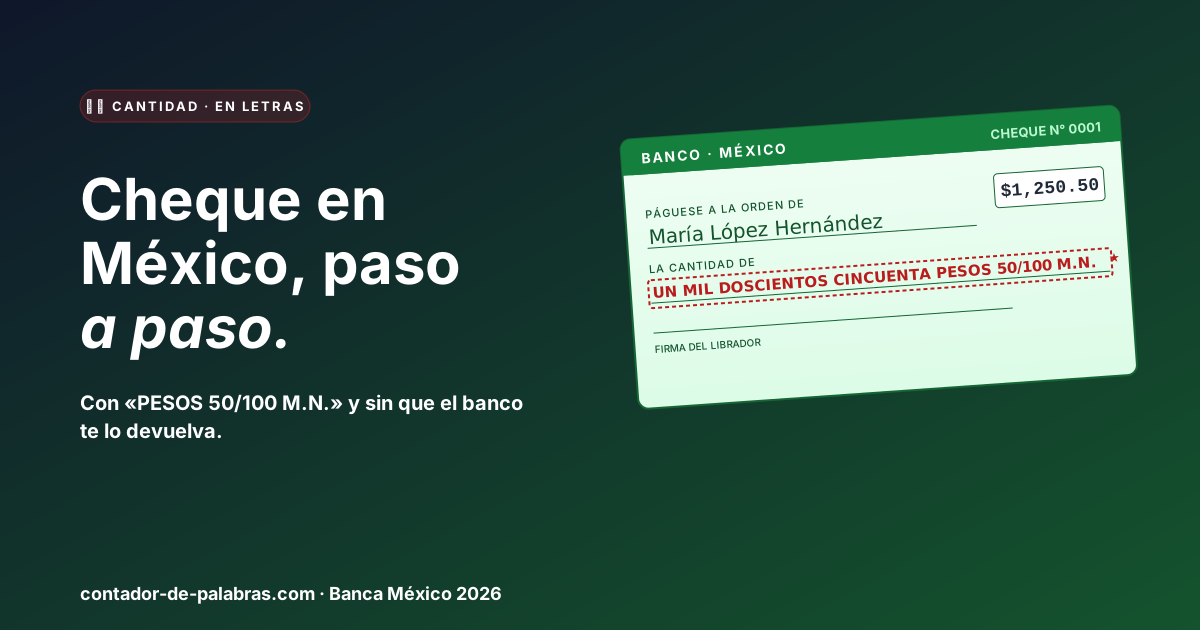
Suppose you need to write a check for $1,250.50 (one thousand two hundred fifty pesos and fifty centavos):
Step 1: Date and payee
Write the place and date of issue (for example, Ciudad de México, a 3 de julio de 2026) and the payee's full name on the "Páguese a la orden de" line. Avoid abbreviations: the name must match the ID the payee will present.
Step 2: The numeric figure
In the box in the top-right corner, write: $1,250.50
Note the format: Mexico uses the comma as the thousands separator and the period for decimals (US style), unlike Colombia or Argentina, where the same amount is written $1.250,50. Start the figure right next to the peso sign so no digits can be inserted in front.
Step 3: The amount in words
On the main line, write in capital letters:
UN MIL DOSCIENTOS CINCUENTA PESOS 50/100 M.N.
Details that make the difference:
- "UN MIL": although the Spanish Royal Academy prefers plain "mil", Mexican banking practice consolidated "UN MIL" to stop anyone from prepending words ("DOSCIENTOS UN MIL…"). Both forms are accepted.
- "DOSCIENTOS" (not "doscientas"), because "pesos" is masculine in Spanish.
- "50/100" expresses the centavos as a fraction of a peso. With an exact amount:
00/100. - "M.N." closes the formula. It is the most visible difference from the Colombian check, which uses no centavos at all and reserves "M/cte" for notarial documents.
Step 4: Signature
Sign exactly as your signature is registered with the bank. A signature that "does not match the signature card" is one of the most common reasons for rejection.
Types of checks in Mexico
- Nominativo (payable to order): made out to a specific person or company. The standard and safest kind.
- Al portador (bearer check): cashable by whoever presents it. Only allowed up to a limited amount precisely because of the risk.
- Cruzado (crossed check): two diagonal lines on the front; it can only be deposited into an account, never cashed.
- De caja (cashier's check): issued by the bank against its own funds; common in real-estate and car purchases.
Mistakes that get checks rejected
BBVA, Banorte, Santander, Citibanamex, HSBC and Scotiabank all apply essentially the same standard. The most frequent returns:
- Crossed-out or corrected text. Don't fix it: void the check and write a new one.
- Figure and words don't match. The teller may reject it even though the law resolves the discrepancy in favor of the words.
- Centavos missing from the words. "$1,250.50" as a figure but "UN MIL DOSCIENTOS CINCUENTA PESOS M.N." in words: inconsistent.
- Signature different from the registered one.
- Post-dated check presented early: in Mexico a check is payable on sight — a future date does not stop the payee from cashing it.
What the law says: the words prevail
Article 16 of the Ley General de Títulos y Operaciones de Crédito (General Law of Negotiable Instruments and Credit Operations) states that when the amount of a negotiable instrument is written both in words and in figures and the two do not match, the amount written in words is the one that counts. That is why the amount-in-words line is not decoration: legally, it is the real figure. Write it as carefully as you sign.
Generate the correct format in one click
Our Mexican pesos to words converter generates the banking format automatically. Type the figure, pick "Check" mode, and copy:
- Adds the "xx/100 M.N." suffix with the right centavos
- Applies the Spanish apocope ("veintiún" instead of "veintiuno")
- Gets the gender agreement right ("doscientos" with pesos)
- Returns capitals ready to write on the check
Frequently asked questions
Can I write the amount in lowercase?
The bank may technically accept it, but the strong convention is capitals: legibility and security. In practice, a lowercase check invites the teller to inspect it with a magnifying glass.
What do I do if I make a mistake?
Void it (write "CANCELADO" across it and keep it for your records) and issue a new one. Mexican banks reject strikethroughs and corrections on the amount, with or without a signature over them.
How long do I have to cash a check?
The LGTOC sets presentation windows: 15 days if cashed in the same city where it was issued, one month elsewhere in the country and three months if it was issued abroad. After that, the bank may still pay if funds are available, but you lose legal recourse against the drawer.
Is writing "M.N." mandatory?
The law does not literally require those two letters, but it does require the instrument to state its currency. "M.N." is the consolidated way of doing so, and every bank expects it. In practice: always write it. More detail in what does M.N. mean?.
What if the check is in dollars?
For foreign-currency accounts (border regions, companies), swap the formula: UN MIL DÓLARES 00/100 USD or "moneda de los Estados Unidos de América". See our dollars to words guide.
Sources
- Ley General de Títulos y Operaciones de Crédito (LGTOC) · articles 16 and 175–207
- Banco de México · check regulations
- CONDUSEF · consumer guides on payment methods
- Real Academia Española · Ortografía 2010