Quick answer
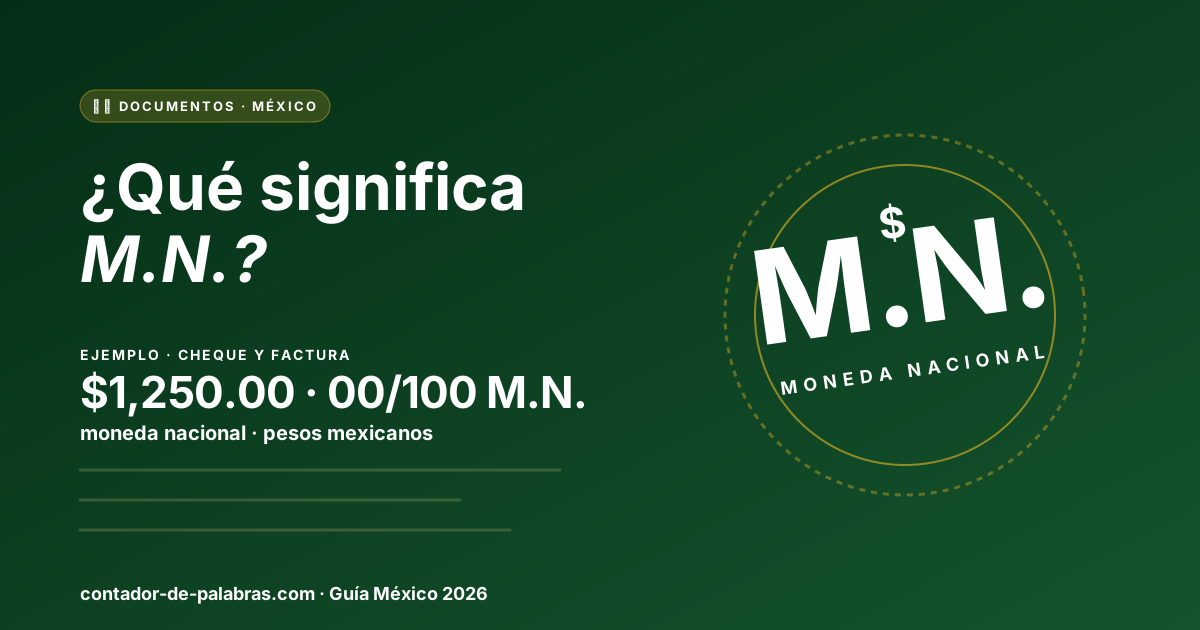
- • "M.N." = "Moneda Nacional" (national currency): legal-tender Mexican pesos
- • It appears on checks, CFDI invoices, contracts, promissory notes and deeds
- • It almost always follows "00/100", which represents the centavos
- • Example:
UN MIL DOSCIENTOS PESOS 00/100 M.N. - • It is not the same as MXN (the ISO code for systems) or the $ symbol
If you have ever filled out a check, reviewed an invoice or signed a lease in Mexico, you have surely run into the letters "M.N." at the end of the amount. This guide explains what M.N. means, where it comes from, which documents use it, what the accompanying "00/100" stands for, and when you actually need to write it.
If you just need to convert a figure into the correct format with M.N., use our free Mexican pesos to words converter: it generates the text with "00/100 M.N." ready to copy.
What does M.N. mean?
"M.N." is the abbreviation of Moneda Nacional ("national currency") and it means the amount is expressed in legal-tender Mexican pesos, the official currency of the United Mexican States (ISO 4217 code: MXN). When a document says MIL PESOS 00/100 M.N., it is specifying that the sum refers to current Mexican pesos — not US dollars, euros or any historical currency.
"M.N." (Moneda Nacional) is the Mexican convention for indicating that an amount is denominated in current Mexican pesos. It is a documentary clarification, not a calculation requirement: the amount is worth the same with or without it, but banks and notaries expect it.
Why did the clarification become necessary? The reason is historical. After the monetary reform of 1905, Mexico distinguished the peso oro — pegged to the gold standard — from other denominations, so documents had to state which "kind" of peso a debt was contracted in; formulas like "moneda nacional" were born there. Decades later the custom came roaring back during the 1993 transition, when the country replaced the "old" pesos with the nuevos pesos (N$) by dropping three zeros: both references coexisted for years, and writing "M.N." removed any ambiguity. The "nuevos pesos" went back to being called simply pesos in 1996, but by then the abbreviation was welded onto Mexican banking and notarial practice.
Where does the abbreviation M.N. appear?
Checks
This is its best-known use. The written amount on a Mexican check ends in 00/100 M.N. (or whatever the centavos are). Banks — BBVA, Banorte, Santander, Banamex — expect this format, and it is the standard way of closing off the amount to make tampering harder. We have a full step-by-step guide to filling out a Mexican check.
CFDI invoices
The CFDI XML does not carry "M.N." (it uses the MXN code in the currency field), but the printed representation — the PDF the customer receives — usually includes the amount in words ending in "M.N.". Most invoicing systems generate it automatically. We cover the details in our article on the amount in words on the CFDI.
Contracts and promissory notes
In leases, car sale agreements, private loans and promissory notes (pagarés), the amount is written both in figures and in words, and the words close with "M.N.". On a promissory note this matters especially: if the figure and the words disagree, the law gives priority to the amount written in words.
Public deeds
Mexican notaries write the price of a real-estate sale fully in words followed by "MONEDA NACIONAL" or "M.N.", plus the figure in parentheses. It is the functional equivalent of Colombia's "M/cte", though with its own format.
The "00/100" explained
You will almost always see "M.N." preceded by a fraction: PESOS 00/100 M.N.. That fraction represents the centavos expressed over a base of 100:
00/100= zero centavos (a whole amount)50/100= fifty centavos07/100= seven centavos
Why write "00/100" even when there are no centavos? For document security: the fraction seals the amount and prevents anyone from appending centavos — or words — afterwards. That is why in Mexico the centavos are never omitted from the written amount, unlike in Colombia, where checks are drawn in whole pesos and the closing is done with the ",oo" formula.
Complete, correct examples:
QUINIENTOS PESOS 00/100 M.N.UN MIL DOSCIENTOS CINCUENTA PESOS 50/100 M.N.DOS MILLONES TRESCIENTOS MIL PESOS 00/100 M.N.
M.N. vs MXN vs $: which one to use where
All three notations coexist in Mexico, but each has its own territory:
- M.N. — Paper documents and legal text: checks, contracts, promissory notes, deeds, printed invoices. It always accompanies the amount written in words.
- MXN — The ISO 4217 code for systems: the CFDI XML, online banking, international trade, exchange rates. It is never used inside the written amount.
- $ — The symbol for numeric figures:
$1,250.50. Since the same symbol is used for US dollars, ambiguous contexts are clarified with "M.N." or "USD" as appropriate.
The same amount can appear in all three forms within a single document: $1,250.50 in the numeric box, UN MIL DOSCIENTOS CINCUENTA PESOS 50/100 M.N. on the written line, and MXN in the system that processes it.
Is writing M.N. mandatory?
No law requires the abbreviation on every document, but practice has made it nearly mandatory on two fronts. First, the banks: a check without the "00/100 M.N." closing may be questioned or rejected at the counter, because the format is part of the anti-tampering measures. Second, notaries and contracting parties: specifying "moneda nacional" removes any dispute about whether the agreed amount was in pesos or dollars — an ambiguity that has proven expensive in litigation.
The practical rule: if the amount is written in words, close it with the centavos and "M.N.". It costs nothing and armors the document.
Write amounts with M.N. in one click
Converting figures to Spanish words without mistakes in apocope ("veintiún", not "veintiuno"), gender ("doscientos pesos", not "doscientas") or millions ("dos millones de pesos") is harder than it looks. Our Mexican pesos to words converter does it automatically:
- Generates the
PESOS XX/100 M.N.format with the right centavos - Uppercase check mode and sentence-case invoice mode
- Runs in your browser, free and with no sign-up
Frequently asked questions about M.N.
Are M.N. and MXN the same thing?
They refer to the same currency (the Mexican peso) but are not interchangeable: "M.N." is the documentary formula that accompanies amounts written in words, while "MXN" is the ISO code used by IT and financial systems. On a check you write M.N.; in an invoice's XML it is MXN.
Is M.N. used in electronic transfers?
No. In SPEI and online banking the currency is defined by the system (MXN) and no written amount is captured. "M.N." belongs to the world of documents: checks, contracts, printed invoices and deeds.
What was the "peso oro"?
After the 1905 monetary reform, Mexico operated with a peso pegged to the gold standard; documents of the era specified "pesos oro" or "moneda nacional" to state which unit an obligation was contracted in. The gold standard disappeared, but the habit of specifying the currency in documents survives to this day as "M.N.".
Is it the same as Colombia's "M/cte"?
They serve the same purpose — stating that the amount is in the current local currency — but each country has its own formula: Mexico uses 00/100 M.N. with centavos as a fraction, while Colombia uses M/cte with the ",oo" closing and no centavos. We explain the Colombian version in our guide to what M/cte means in Colombia.
Sources and references
- Banco de México (Banxico) · history of the peso and the 1993 reform (nuevos pesos)
- Monetary Law of the United Mexican States
- General Law of Negotiable Instruments and Credit Operations (LGTOC)
- SAT · Anexo 20, the CFDI technical standard
- Real Academia Española · Ortografía 2010